|
TECSTOR
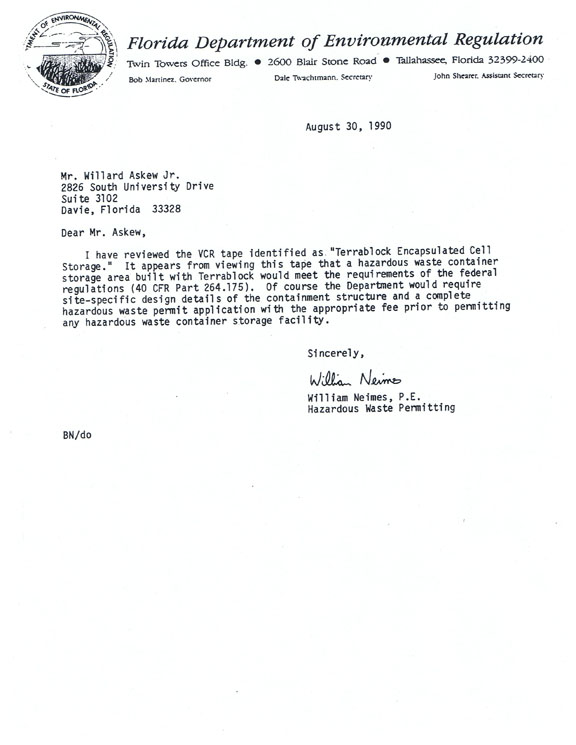
TECSTOR stands for Terra Block Encapsulated Cell Storage and is a new, state of the art method for storing low-level, bio-hazardous waste materials. TECSTOR consists of a virtually indestructible facility that was invented by retired NASA engineer and Terra Block founder, Robert Gross. The
facility provides for the safe and permanent storage of short-lived radioactive materials, such as medical isotopes from hospitals and also ancillary refuse from commercial power plants; filters, clothing, contaminated tools, contaminated earth, power transformers, discarded computers and monitors and the like. These types of materials do not require deep storage. A 1980 federal law states that landfills are sufficient and allows states to individually handle the storage, under the guidelines of the 1976 Resource Conservation and Recovery Act (RCRA). The problem here is that without material-specific safeguards, the earth and natural water tables of these landfills will most likely be contaminated.
In 1997, 20,316 Large Quantity Generators ("LQG's") reported they generated 40.7 million tons of RCRA hazardous waste, up from 36.3 million tons in 1995 or an increase of 11%. This report does not consider wastewaters or the smaller generators of hazardous waste, which are estimated to be in excess of 250,000! There are over 85,000 product and service companies that are in need of a storage system that would safely and permanently house low-level, bio-hazardous waste materials. EPA identifies 21 pages of hazardous waste materials. These include potentially lethal polychlorinated byphenyls (PCBs) and halogenated volatile organic compounds (VOCs), which are found in many common items and areas. These products must be transported to active, permitted RCRA treatment, storage, or disposal facilities (TSDs). A TSD is defined as any facility, which treats, stores, or disposes of RCRA hazardous waste, regardless of the quantity managed.
The primary method of hazardous waste storage in the United States is land disposal. In 1997, land disposal accounted for 76% of the national non-wastewater management total. Land disposal methods include:
 With the Deep well/Underground method, there is much speculation that this could contaminate the earth and underground water supplies and eventually work its way to the surface. The best method would be to provide the isolation of Deep well/Underground Injection, utilizing the convenience of Landfills and Surface Impoundment, without the usual accompanying dangers of leaking or exposure.
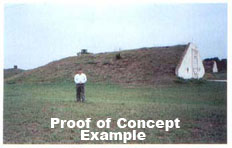
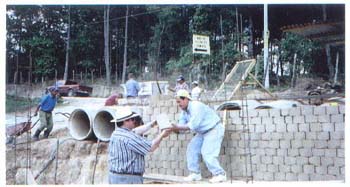
This is exactly what the TECSTOR System does. The patented TECSTOR System consists of an aboveground building constructed with Terra Blocks which are incredibly sturdy, fireproof and chemically stable. Because of the composition of the Terra Block, the TECSTOR structure meets the "buried" requirement. Underneath the building lies a protective cistern that is protected by an approved liner material guaranteed to withstand almost any chemical leakage. Several layers of clay cover the liner. The interior is divided into cells, also made of Terra Blocks and a temporary frame roof
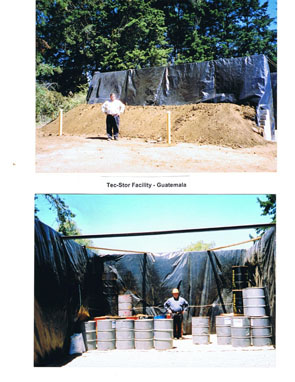 covers the building during the filling process. The entire facility is equipped with sensitive vapor detectors. The building is approximately 1,100 feet long and approximately 66 feet wide, with an interior height of 14 feet. The hazardous waste is first stored in containers that are placed into a chemically impervious over pack liner. More containers are then stacked on top of the first clay-lined layer until the layers are filled. Another coating of liner film is then laid, followed by tons of fill dirt. This forms an airtight seal, which is important in maintaining safe storage standards. Numerous leakage sensors strategically placed around and in the structure permit the detection of even the smallest leak. However, the amount of clay that is packed around each container of hazardous waste, is sufficient to absorb any leak. Because of the above ground feature of the facility, if there is a leak, it can be localized to a specific cell. That cell can then be breached, the leak corrected and the cell resealed. This provides additional safety as well as long tem cost savings for the operator. covers the building during the filling process. The entire facility is equipped with sensitive vapor detectors. The building is approximately 1,100 feet long and approximately 66 feet wide, with an interior height of 14 feet. The hazardous waste is first stored in containers that are placed into a chemically impervious over pack liner. More containers are then stacked on top of the first clay-lined layer until the layers are filled. Another coating of liner film is then laid, followed by tons of fill dirt. This forms an airtight seal, which is important in maintaining safe storage standards. Numerous leakage sensors strategically placed around and in the structure permit the detection of even the smallest leak. However, the amount of clay that is packed around each container of hazardous waste, is sufficient to absorb any leak. Because of the above ground feature of the facility, if there is a leak, it can be localized to a specific cell. That cell can then be breached, the leak corrected and the cell resealed. This provides additional safety as well as long tem cost savings for the operator.
The TECSTOR System is the result of over 15 years and in excess of one million dollars of research and development. TECSTOR is also a containment remedy, which is the fastest growing method being utilized for hazardous waste storage. It is a state of the art facility that has provided safeguards that will insure the safe and permanent storage of low-level, bio-hazardous waste materials, allowing waste generators to affordably comply with federal storage laws. TECSTOR is also designed, that when the facility is full, the entire structure can be covered with dirt and grass seed planted, resulting in a natural looking berm or mound of dirt.
The Hazardous Waste Crisis
As the world has made incredible advances in technology, it has also added another element that continues to grow each year - hazardous waste. In the United States alone, there are over 200,000 sites requiring clean up, at an estimated cost of $200 billion! Worldwide, the problem of what to do with hazardous waste has become a tremendous problem, with illegal dumping becoming epidemic. Black market profiteers have made incredible fortunes by running clandestine dumping operations worthy of a James Bond movie. The victims are usually Third World countries, where the hazardous waste is either dumped unknowingly or they are enticed by the prospects of multimillion dollar boosts to their economies, often making these deals with little understanding of the health and environmental dangers involved. Most developing countries have neither the technical expertise nor adequate facilities for safely recycling or disposing of these hazardous wastes.
It is to this end that TECSTOR was designed. Nations, regions, states and individuals are beginning to understand that until a method is developed that can safely destroy hazardous waste, it has to be dealt with or it will continue to be dumped in an unsafe manner, harming the Earth's environment. TECSTOR accomplishes this objective. TECSTOR is economically feasible, TECSTOR is permanent, and above all, TECSTOR is safe. Poverty stricken nations can benefit from TECSTOR, not only in being able to safely store their own generated hazardous waste but benefiting financially as well, from TECSTOR potentially as a hard currency generating business.
|

|
|
Copyright 2006 -
Terra Block Inc. |